
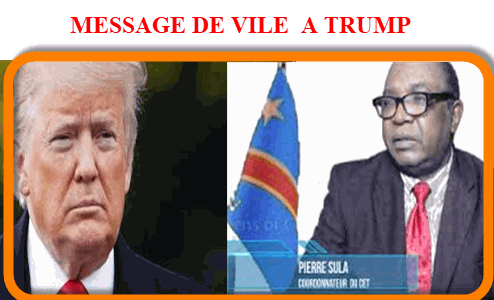
Dear President Trump:
As an American of Congolese origin and coordinator of a group for reflection and action (Think-and-Do Tank) whose goal is to rebuild the Democratic Republic of Congo (DRC), I would like to share with you our group’s opinion on the government’s appointment of Mr. J. Peter Pham as US representative for the Great Lakes region of Africa.
We are not challenging your legitimate prerogatives to appoint people of your choice to administrative, political, or diplomatic functions to serve the nation. Instead, we would like to enlighten you on a better way to achieve peace in the DRC and further the interests of the United States in Congo for the benefit of both countries.
We strongly believe the following:
- Peter Pham has biased views on the DRC that would hurt American interests.
- The DRC’s situation requires a change of strategy of the international community to guarantee the effectiveness of the assistance.
- The DRC deserves the United States’ support for its reconstruction for a promising relationship for the future of the two countries.
These are the main ideas we are presenting in this note. We are willing to share more details with your administration.
- PETER PHAM HAS BIASED VIEWS ON THE DRC THAT HURT AMERICAN INTERESTS IN THE DRC.
In a New York Times article published on November 30, 2012, Mr. Pham made a highly controversial statement, questioning the existence of the DRC. Here is an excerpt:
… If some enterprises, public or private, can be said to be “too big to fail,” Congo is the reverse: it is too big to succeed. It is an artificial entity whose constituent parts share the misfortune of having been seized by the explorer Henry Morton Stanley in the name of a rapacious 19th-century Belgian monarch. From the moment Congo was given independence in 1960, it was being torn apart by centrifugal forces, beginning with separatism in the mineral-rich southern province of Katanga.
The international community has repeatedly dodged this reality by opting for so-called peace deals with shelf lives barely longer than the news cycle. Rather than nation-building, what is needed to end Congo’s violence is the opposite: breaking up a chronically failed state into smaller organic units whose members share broad agreement or at least have common interests in personal and community security. To save the Congo, Let it Fail Apart
According to Mr. Pham, the misfortunes of the DRC come from the ethnic heterogeneity of the country. The destabilization of the Congo in 1960, just five days after the country’s legal independence, especially the secession of Katanga (its most mineral-rich province), would have been due to centrifugal forces that would still be dominant in Congo since the departure of white power.
Mr. Pham should know that, in 1975, the US Senate Church Committee as well as the Belgian Senate (in 2002) had already recognized the responsibility of the Western powers in the destabilization of the Congo in 1960. Mr. Pham seems to also ignore that a Secretary-General of the United Nations, Dag Hammarskjöld, on a mission in the Congo, was cowardly murdered in 1961. Did Hammarskjöld belong to one of the tribes in the Congo? His plane was shot down by people who sponsored the Katangese secession.
As a solution for stability in the DRC, Mr. Pham advocated a balkanization of the country, which would transfer the power of the state to ethnic groups. To our knowledge, since publication of the New York Times article, Mr. Pham has never evolved from this view.
President Trump, because of these racist and anti-Congo views, the appointment of Mr. Pham is likely to give credence to the repeated assumption that the United States would be engaged in a plan for the balkanization of the DRC. We believe that the appointment of a person with such views to a key position in the Great Lakes region of Africa, where covetousness on Congolese territory is not in doubt, is an existential threat to the DRC. This is in total contradiction to the protection of US interests in the DRC and in Africa.
Mr. Pham should have known better before making such a statement publicly. He would have found out, from the Somali example, that the dilution of the power of the state in Africa for the benefit of ethnic leaders can only create greater anarchy that is detrimental to peace and international order.
Balkanizing the DRC would bring about a large-scale destabilization: it would be impossible to contain this destabilization in the Congo—a country one-fourth the size of the United States with nine bordering countries. Contagion to neighboring countries would cause even greater misery to over a hundred million people living in Central Africa. This would create strong geopolitical and migratory pressure.
Remember that the last Balkanization attempt of the Congo took place in 1998. It led to the “First African World War.” It necessitated the full attention of the international community through the 1999 Lusaka Ceasefire Agreement to extinguish it before a general conflagration of all of Central Africa.
Views as wrongheaded as those of Mr. Pham not only pose an existential threat to the DRC but also to Africa’s stability and international peace. We believe that, to dispel any misunderstanding, the White House must unambiguously denounced these views.
THE NEED FOR A CHANGE IN STRATEGY TO EFFECTIVELY ASSIST THE DRC
The Congolese are proud of their great country and are grateful to the United States for supporting its creation at the Berlin Conference in 1885. They remain proud to belong to one nation, in the diversity of their ethnic groups. If ethnic heterogeneity was a barrier to the formation of modern nations, great nations such as the United States and India, among others, would not have become strong and democratic nation-states. Building a strong nation from an ethnically heterogeneous, though difficult, is possible if the state is organized first. Indeed, the manifestations of the centrifugal forces – of which Mr. Pham seems to believe that they are only peculiar to the Congolese – are inherent to any society. They are only harmful when there is a deficit of the centripetal forces generated by the good functioning of the State.
We believe that the situation in Congo requires a change of strategy of the international community in the prioritization of assistance to the DRC. It would be counterproductive to want to graft the pattern of Western democracies on the Congo, where the state does not function and the society is very fragmented. It is not the lack of democracy and ethnic diversity that constitute the main problem of the DRC. It’s the absence of a functioning state. When Germany, Japan, and South Korea faced the same post-war situation, the United States put considerable effort into getting the state back on its feet. Afghanistan receives large grants to increase the state capacity. For some reasons, the Congo has never received sufficient assistance to start rebuilding the state. Yet the United States has experience in this area.
Rather than speeding up the « democratization transplantation » campaign in the DRC, which has no chance of succeeding with the absence of a functioning state, the United States should first support the establishment of prerequisites for democracy which are:
- Respect for the laws. The existence of an executive power that enforces the laws and respects them is the first prerequisite for democratization. It is important to note that it is not democracy that is a prerequisite for the respect of the laws: it is the opposite. Thus, all militias must be disarmed in the DRC.
- The development of a national economy to lift the country out of poverty. We know that in poverty, sustainable democratization is unlikely.
- The State Legitimacy. « Legitimacy » being defined as the ability of a political system to engender and maintain the loyalty or self-submission of citizens to institutions. This does not necessarily result from elections, but from the good management of the citizens’ expectations for the satisfaction of their basic needs, especially the right to security and sustenance.
- The emergence of a democratic culture. This requires time and must be done gradually. Because, whatever the external pressures for the democratization of the country, habits acquired long ago (especially through colonization and religion), the norms and political culture of a society do not change overnight.
PS: the creation of institutions capable of increasing the capacity of the State must, in all cases, take precedence over the organization of elections.
REMEMBERING THE PAST TO BUILD THE FUTURE OF US/DRC RELATIONS
As US citizens, we are proud of the assistance the United States provides to the DRC through MONUC (the United Nations Organization Stabilization Mission in the Democratic Republic of the Congo) and bilateral assistance. Nevertheless, we believe the United States should do better, not only because of a moral debt to the Congolese people but also to build new, mutually beneficial relations.
With respect to the US moral debt to Congo, we have no vindictive intent. These are historical facts: Although the Congolese know that they cannot live in the past, they would like US leaders to remember the suffering they endured as a result of the causes defended by the United States.
From 1940, when Hitler’s Germany conquered most of continental Europe to the end of the Cold War in 1992, the Congo remained in the same camp the United States controlled. This required the mobilization of many resources. The Congo has played an important role as provider of strategic raw materials, so much so that we can say without pretension that by the sweat, the blood, and the resources of their country, the Congolese have also contributed to the victory of the United States.
During the Second World War, two resources proved to be of strategic importance: the industrial diamond (allowing the production of precision tools necessary for the manufacture of guns, planes, ships, and submarines) and uranium, both sought by all the powers involved.
Seventy percent of the industrial diamonds in the world came from the Congo. Furthermore, all the uranium used in the manufacture of the first atomic arsenals of the United States, including the bomb launched on Hiroshima, was extracted from the Congo. By controlling the Belgian Congo during the Second World War, the United States and Great Britain secured an advantage over the Axis powers.
In 1954, cobalt, another resource mined in the Congo, became part of the variety of strategic minerals used in the Cold War. Cobalt is an important material for the manufacture of jet engines and missiles. Since then, Congo has produced nearly three-fourths of the cobalt for the Western world. Congolese cobalt facilitated the arms race and the space race for the United States.
However, as a result of efforts to meet US uranium requirements through internal production, uranium was losing its strategic interest by 1960. But despite the concreting of the Tshikolobwe mine by Belgium in April 1960, the United States could not tolerate the Soviets getting close to it, and it was in the national interest of the United States to ensure its access to cobalt.
In addition, as many modern history auteurs recognize it, during the 1960s and 1970s, as the possibility of a Third World War was still extremely strong, and given that the DRC (then Zaire) was located at a geostrategic location, allowing the transit of aircraft between the Atlantic and the Pacific, the United States established a so-called pseudocolonial regime in the DRC.
The pseudocolonial regime under the United States in Congo lasted forty years and only exacerbated the atomization of the Congolese people -started in slavery and colonial times with forced labor-that prevented the possibilities of development of postcolonial Congo.
After 1960, the Congo was kept under a control regime that did not allow the learning of democracy. Thus Patrice Lumumba, the father of the Congolese nation, paid for it with his life.
President Trump, the turbulences of the Congo since the fall of the Berlin Wall are not the consequence of ethnic heterogeneity. They are the consequence of the acceleration of democratic demands, while the institutions of the states are still far too weak and unable to absorb them. Also, the political class still lacks a democratic culture.
Rather than speeding up the DRC’s “democratization transplantation” campaign that has no chance of succeeding in the absence of a functioning state, the United States should first support the increase of the state capacity and the achievement of the prerequisites for a sustainable democratic transition described above.
Despite its current difficulties, the DRC remains one of the richest countries in the world in terms of natural resources. According to estimates by the US Geological Survey, unexploited mining deposits in the DRC represent about 24 trillion dollars. The largest reserves of cobalt and coltan in the world are in the DRC. It has huge hydropower potential and also a young population—more than 80 million people who are more educated than those in other central African countries.
The DRC is, therefore, a country with great potential that needs the deserved assistance of both the United States and other Western countries (which have benefited greatly from its resources and are also responsible for its current underdevelopment) to improve other factors of production and help the Congo produce more exportable finished materials without any vindictive afterthoughts.
President Trump, we believe that Mr. Pham owes explanations to Congolese Americans like us, who, while proud to be Americans, cannot tolerate the deterioration of relations between the United States and the Congo in this twenty-first century, where Congolese resources can be important assets for the development of new technologies, including electric cars and computers.
President Trump, we are ready to sit with the members of your administration to explain in detail our proposals on the reconstruction of the DRC because the Congo should remain independent, one and undivided forever.
Pierre Vile-Linda SULA Cedar Falls, 15th of November 2018
CET Coordinateur

